Biography of Brethren in Christ Historian Released at Annual Meeting
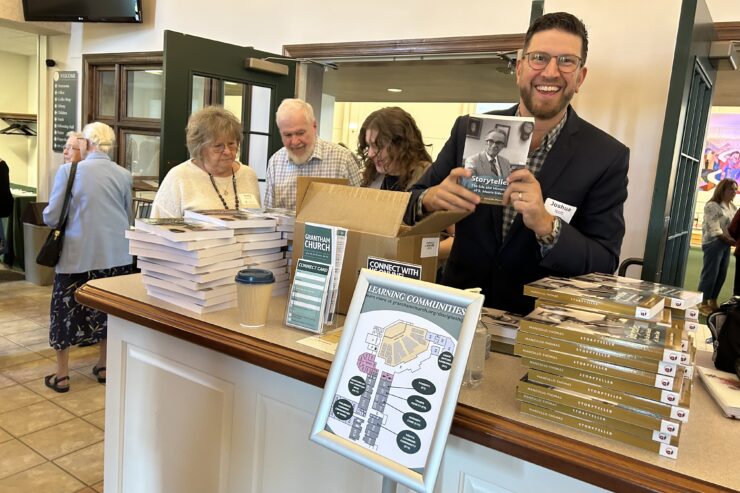
Society executive director Joshua Nolt holds up a copy of Storyteller.
About 135 people attended the Historical Society’s annual meeting on October 4 at the Grantham (PA) Brethren in Christ Church where the new biography, Storyteller: The Life and Ministry of E. Morris Sider by Devin Manzullo-Thomas, was released. The event began with a catered lunch and homemade pies for dessert following a tradition begun by Morris’s wife Leone, and continued with a conversation featuring Morris, now almost ninety-seven years old, Devin, and Joshua Nolt, Historical Society executive director.
Morris related the history of the Historical Society, noting that Martin Schrag, former professor at Messiah University was the first to suggest the idea in 1976. A proposal was brought to a forum at the 1976 General Conference, and by 1978 Morris had written a constitution and the Society was launched at the bicentennial conference with the support of denominational leadership. The first annual membership fee was $5.
Reflecting on the title of Devin chose for the new biography, Morris described stories as illustrations of truth, “microcosms of the macrocosm,” attention getters, and persuasive. He saw the storytelling he did in his books as his service to church.
In Devin’s remarks about writing the book, he noted that much of his inspiration came from Morris ’s love for the church and the way he modeled the value of historians to the church in preserving and interpreting the past. Morris’s influence also included the way he told careful, cautious, and deliberate stories about real people. He treated his subjects with respect and dignity, and yet he told the truth and didn’t sugarcoat reality.
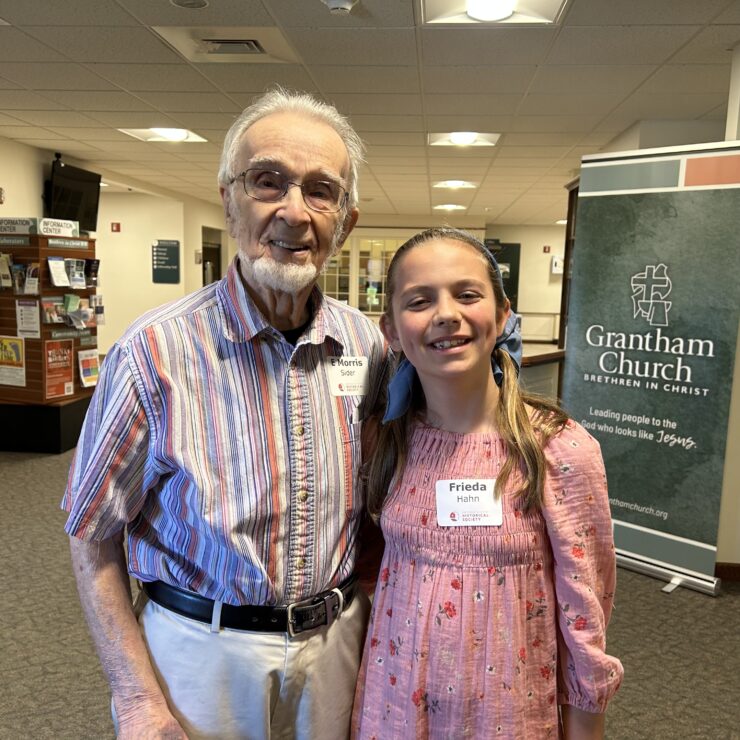
Morris poses with one of his young readers, Frieda Hahn.
All members of the Society should have received a copy of the book. More copies are available for sale at $12.00 each, plus postage. The book is wonderful reading for all who knew Morris and Leone and for anyone who is interested in the story of the Brethren in Christ Church’s preeminent historian. A copy should be in all church libraries! To order a copy (or two or three), contact the editor for more information.
Renew Your Membership; Give a Gift Membership
Rather than send a separate renewal letter or postcard, we are including a self-addressed envelope in this edition of the newsletter. In addition to renewing your own membership (see the expiration date on the newsletter label), we invite you to give a membership to someone else. We especially encourage older members to give a gift to a young person as a way to introduce the Society to a new generation and thus help to sustain the Society. The gift membership is a two-year deal for $50—a discount of $10 over the regular price.
A Storyteller's Philosophy
By E. Morris Sider
Why is it important that we use stories to communicate our faith and heritage? I suggest several answers.
First, it is important to tell those stories because they give continuity to our lives. I assume that all of us reject an existentialist philosophy of life. Instinctively we feel that we are part of a chain of life that has a past, a present, and a future. We identify easily with Alex Haley and his Roots (whether his book or its TV version) as he sought for his past, not just in the limited past of his family’s beginning in the slave days of America, but all the way back to his ancestral home on the African continent. It is the same search for continuity that brings people and letters to our Brethren in Christ Archives in search of their family roots.
My point, of course, is that storytelling, whether on a family or church level, helps to fulfill this instinctive search we have for the continuity of our lives. Stories help to bind us to the people of our past.
It is also important to tell stories of our past because they help to fulfill a closely related need—establishing our identity. Who are we? We may ask this of ourselves, both as individuals and as a denomination. Where do we come from? How does our past shape us in the present? How do the experiences of our church past make us different from other denominations? Unless we know something of the answers to these questions, we are not likely to be knowledgeable about ourselves or convincing to others.
I think it may be largely questions of identity—questions of understanding who we are—that lie behind much of the storytelling that children ask of their parents. I suspect that many parents experienced (or are presently experiencing) what Leone and I did when our children were growing up. Every night we told Karen and Donna [our daughters] stories after they were in bed. Sometimes we read them stories. But most often they would say: “Tell us a story about when you were young” (as if, of course, we were then old people!).
In later years I asked Donna to tell me what stories she remembered us telling her at bedtime. She named about a dozen or so (stories we told repeatedly), and every one of those that she recalled were stories Leone and I had told about our personal past.
I suspect that at least in part what was going on in Karen and Donna’s minds was something like this (although not expressed in such sophisticated terms): Who are my parents? What are they really like? What are the forces that shaped their lives and made them what they are? Who are these people with whom I share my life and who will be shaping my life? . . .
[In addition,] it is important to tell stories because they are effective means of instruction. That principle has been recognized everywhere and from the earliest histories. Storytelling was largely the way the Hebrews instructed their children. Parents were to tell their children daily and in every place the stories of the great saving acts of God in their history, and in the telling of those stories, the children would come to understand and believe.
But why stories, you may well ask. Surely there are other media that we can use to communicate faith and transfer heritage. Can we not do this by sermon, by catechism, by prayer and praise? We rightfully use all of these, of course, in the transferring of faith and heritage. But there is something particularly effective about the story form. Three reasons may be cited for this effectiveness.
First, stories are usually about individuals—usually one, sometimes two or three. This serves to give a focus, or to concretize, the point to be made. In storytelling, the point is usually not made in generalities or in theological abstractions that may be difficult for even educated people, let alone children or new converts, to understand. . . .
Second, and relatedly, the story form is effective because it helps the reader to identify with the point to be made. It is difficult to identify with a generality, a theological abstraction. . . .
Third, stories are effective because they are attention-getting. They have life. They are about live people (or at least live at one time). They have plot, development, sometimes sudden turns of fortune. Stories are not just dead history or dull sermons. Thus they can be effective in communicating faith and transferring heritage.
We do have a good heritage to communicate. Let’s work well at communicating it effectively. Let’s tell stories!
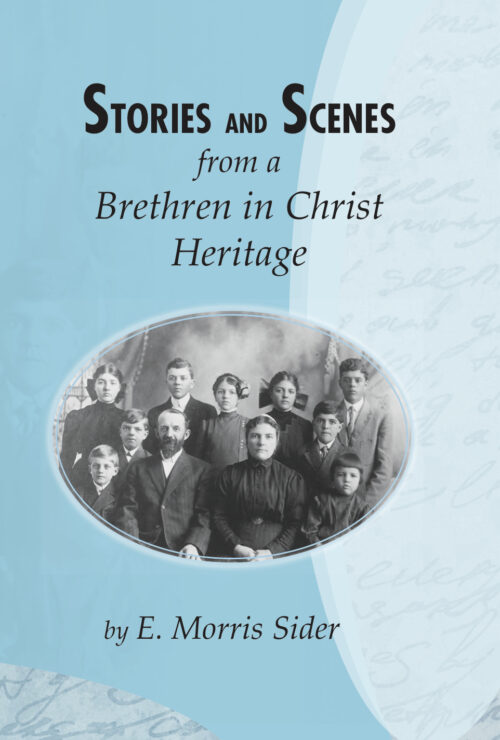
Morris Sider has written more than thirty books about Brethren in Christ people and institutions. In retirement, he lives at Messiah Lifeways, Mechanicsburg, PA. This article is excerpted from Chapter 1 of his book, Stories and Scenes from a Brethren in Christ Heritage, published in 2018 by the Historical Society. Copies of the book are still available for $12 each plus postage. Contact the editor.
News and Notes from the Brethren in Christ Historical Library and Archives
On Writing a New Denominational History, Part 1
By Devin Manzullo-Thomas
In 2028, the Brethren in Christ Church U.S. will celebrate its 250th anniversary. Several years ago, in anticipation of this milestone, I was invited by the Brethren in Christ Historical Society to contribute to marking this anniversary by writing a new denominational history—an invitation that I gladly accepted, for two reasons.
First, I accepted the invitation because I am trained as a historian of Christianity and I love researching and writing about that topic—especially the history of our branch of the Christian family tree, the Brethren in Christ Church.
Second, I accepted the invitation because as the director of the Brethren in Christ Historical Society and Archives, I am quite literally surrounded by the sources that can inform a new denominational history.
Tentatively titled Open to the Spirit: The North American Brethren in Christ Church in the Twentieth Century, 1900-2000, the book is still very much a work in progress. Nevertheless, I have quite a few goals that I hope to achieve in writing this new denominational history.
One of my top goals in writing this book is simply to bring the story of the North American Brethren in Christ up to date.
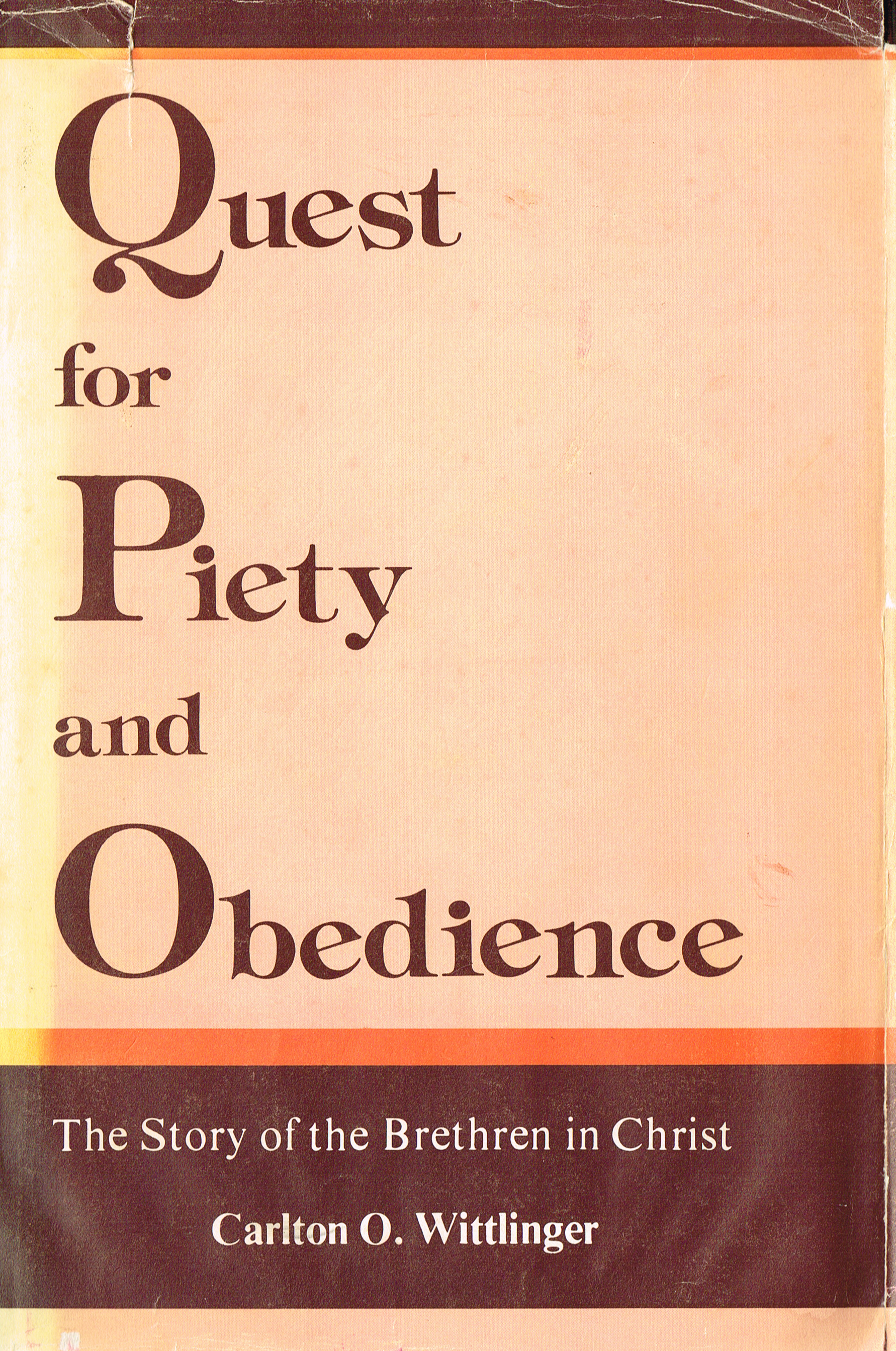
Quest for Piety and Obedience, the current standard history of the Brethren in Christ Church in North America, was published in 1978 by Dr. Carlton Wittlinger.
The most recent comprehensive denominational history of the Brethren in Christ Church was published in 1978—on the occasion of the church’s bicentennial anniversary—and written by Dr. Carlton O. Wittlinger, a credentialed Brethren in Christ minister who served the church as a history professor and archivist at Messiah College from 1943-1979.
Wittlinger’s book, Quest for Piety and Obedience: The Story of the Brethren in Christ, covered the history of the denomination from its founding around 1788 to about 1950.
Like every other Protestant denomination in North America, the Brethren in Christ Church has experienced significant change throughout the twentieth century—change that makes Wittlinger’s account pretty out of date. My project intends to fill that gap, by chronicling what has developed in the years since Wittlinger wrote.
While there hasn’t been a new comprehensive denominational history written since 1978, there has been a lot of research on the Brethren in Christ published since that time—much of it published by the Brethren in Christ Historical Society in its journal, Brethren in Christ History and Life. Therefore, my second goal in writing this new denominational history is to incorporate that body of research. In other words, I plan to synthesize what has been written already with the new research that I will do.
My final goal is to make this book readable—in at least two senses of the term. First, I want this book to be readable in the sense of being accessible to a wide range of readers. I imagine that this book will be of greatest interest to my fellow historians: historians of the Brethren in Christ Church and related denominations, such as the Mennonite Church USA, the Wesleyan Church, and others. But another audience that I have in mind is non-scholars: pastors, bishops, and laypeople within the Brethren in Christ Church and with ties to the denomination.
To reach this audience, I need to write in a style that is invitational, that captures the attention and the imagination, and that doesn’t assume a great deal of prior knowledge about church history, about North American history, or about the history of the Brethren in Christ.
Second, I want this book to be readable in the sense that it is entertaining and illuminating. Denominational histories have a reputation for being dry histories—histories that are boring or at least difficult to get excited about. Partly that reputation derives from the fact that denominational histories are often accounts of the development of an institutional church—accounts of changes in organizational structure or changes in in doctrinal statements. Those kinds of histories tend to obscure or at least downplay historical actors. The histories become impersonal.
Even when they’re not impersonal, these institution-focused histories mostly chronicle the actions of denominational leaders—people in formal positions of power and authority.
Historians of American Christianity (like me) know that the life of the church has been influenced by more people than just those with formal titles and positions up the denominational hierarchy. Local pastors, missionaries on the ground, and laypeople in the pews were also playing important parts in the drama of Brethren in Christ church life during the twentieth century. Women and people of color were also important historical actors, even if their actions weren’t captured in official denominational records.
Therefore, when I say that I want to make this book readable, part of what I mean is that I want to expand the cast of characters—of historical actors—who are part of this history. Such an expansion requires me to engage historical methods—methods of archival and oral history research—that differ from, say, those employed by Carlton Wittlinger in the 1960s and 1970s. By doing so, I hope to tell a story that’s more compelling and thus more readable to my intended audience.
In a future issue of this newsletter, I’ll say more about my research process and how I hope to use records and other materials from the Brethren in Christ Historical Library and Archives to tell this more complete, readable story. Stay tuned!
Images from the Past
From the Photograph Collection of the Brethren in Christ Historical Library and Archives
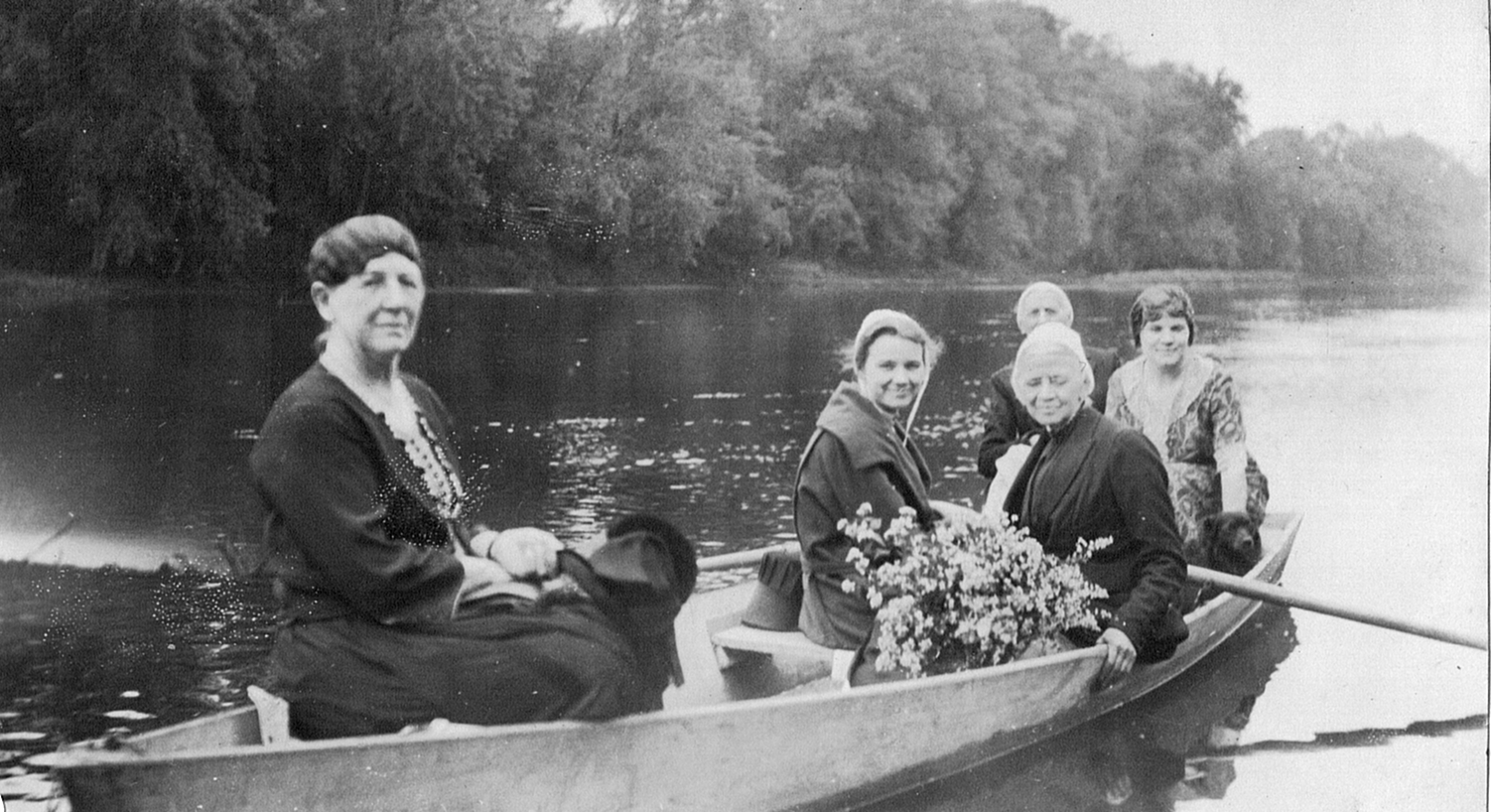
Early Brethren in Christ missionaries to urban centers lived between the city and the country. Most moved from rural places—farms and small towns—to bustling metropolitan areas so that they could share the gospel. Reports from these pioneers often framed the city as a place of immorality and social disorder. By contrast, the country was a place of orderliness, beauty, and simplicity—a place of rest and recovery.
This photo documents one such retreat to the country for workers and others connected to the Brethren in Christ’s Chicago Mission, including Sarah Bert, a pioneering urban missionary (third from left, with flowers). No other information is known about this event, although it is possible that the image was captured on the Fox River near Aurora, Illinois, where Bert on more than one occasion visited family friends, the Henry Stoners. (For more on this, see Morris Sider’s biography of Bert in Nine Portraits: Brethren in Christ Biographical Sketches, p. 24.)

 First, stories are usually about individuals—usually one, sometimes two or three. This serves to give a focus, or to concretize, the point to be made. In storytelling, the point is usually not made in generalities or in theological abstractions that may be difficult for even educated people, let alone children or new converts, to understand. . . .