On Writing a New Denominational History, Part 2
By Devin Manzullo-Thomas, archivist
In an earlier issue of this newsletter, I described the goals I’m seeking to achieve in writing a new history of the Brethren in Christ Church in North America. Tentatively titled Open to the Spirit: The North American Brethren in Christ Church in the Twentieth Century, 1900-2000, the book seeks to bring the story of the North American Brethren in Christ Church up to date, to synthesize new research with the many books and articles on Brethren in Christ history that have been written in the last fifty years, and to be readable and compelling to a wide audience.
How will I do that? What kind of sources am I drawing upon in my research and writing, and how do I plan to use them?
Perhaps the best way to answer those questions is to compare my sources to those of Dr. Carlton Wittlinger, whose magisterial Quest for Piety and Obedience: The Story of the Brethren in Christ has been the standard denominational history since it was published in 1978, during the North American church’s bicentennial anniversary.
If you peruse the endnotes of Quest for Piety and Obedience, you’ll notice that Wittlinger relied primarily on published records as the sources for his historical writing. These records include:
- The Evangelical Visitor, the official newspaper of the Brethren in Christ Church in North America from 1887 to 2004;
- The Minutes of the Annual (later Biennial) General Conferences, the official decision-making body for the North American church;
- The minutes of various church districts and conferences, local decision-making bodies;
- Minutes and reports produced by denominational boards and committees; and
- Personal interviews with church leaders who lived through the periods of time that he interpreted.
Much less frequently did Wittlinger use what archivists call personal papers: materials produced by individuals, such as diaries, letters, photographs, and other similar items. These kinds of records were often not available to him, because when he was working on his book, the Brethren in Christ Archives at Messiah University were still in their infancy.
What about my sources? In researching and writing my book, I am also using the same denominational records that Wittlinger used. At the same time, I am benefitting from the growth of the Archives over the last five decades. A wealth of individual papers and new institutional records have been deposited in the Archives since the 1970s, including the personal papers of ministers, bishops, administrators, educators, and laypeople. These materials document the lives of their creators, giving us a richer portrait of what it was like to be, for example, a Brethren in Christ pastor in rural Kansas in the 1940s, or a Brethren in Christ bishop in the turbulent decades of the 1960s, or a Brethren in Christ missions administrator in Lancaster County, Pennsylvania, in the 1980s.
These kinds of sources also give us glimpses of matters beyond what their creators intended. Consider, for instance, the rich correspondence that bishops carried on with individual Brethren in Christ members during the middle decades of the twentieth century. Bishops kept and preserved these letters presumably as a record of their work—of the advice and spiritual counsel that they gave to members, of the quotidian business of the church that they carried out. Yet these letters also offer us something beyond this record: They tell us not just what the bishops said, but also about the struggles, the daily life, and the spiritual experiences of the average Brethren in Christ lay person who was writing to their bishop.
Allow me to illustrate this point with one example. In 1943, Agnes Cober—a teenager in the Markham District in Ontario, Canada—wrote to Henry Ginder, then a young bishop in Lancaster County, Pennsylvania, who, at least in Agnes’s mind, understood (as she puts it in her letter) “young people and their different problems.” Agnes was having problems, according to her missive—spiritual problems, most of them centered on her “mixed up” experience of sanctification and the spiritual temptations she was having related to plain dress. Specifically, she reported that many of girls in the Markham Church were exchanging their black stockings for lighter ones—and Agnes was feeling torn between giving into peer pressure and maintaining what she understood to be the church’s biblical teaching. “It seems so hard to stand up for your convictions and do what you ought to do,” Agnes wrote. “If it’s really right to wear [plain dress] why is it we’re so tested about [it]? Or is that just the devil trying to make us give up little by little? . . . I know I’ve made many mistakes in the past, but I am determined by the Grace of God to go through even if I don’t understand lots of things.”
What does this letter tell us? If you’ll forgive the pun, Agnes Cober’s letter offers a colorful illustration of the struggle over plain dress that engulfed members of the Brethren in Christ Church in the middle decades of the twentieth century. It offers a rich, textured portrait of one church member’s internal and external wrestling with conflicting messages—one from her peers, one from church elders.
It also offers insight into the regional variations in the practice of plain dress among Brethren in Christ. In Agnes’s letter, black stockings are portrayed as essential to the plain dress standard at least in the Markham District, if not in all of Ontario. We would probably find different expectations if we read Agnes’s letter alongside letters from the same period from Brethren in Christ young women in, say, Southern California or northern Ohio.
Finally, it’s worth pointing out that this letter gives us insight into the experience of a Brethren in Christ woman: her struggles, her concerns, her spiritual needs and desires. Such specificity would be difficult to find in a published church record because in large part those records were written by men who had struggles, concerns, and spiritual needs and desires of their own. Of course, not all published records of this time were written by men—women were often published in the Visitor, for example—and sometimes struggles, concerns, and needs and desires were shared across gender differences. Nevertheless, the kind of unpublished, personal document that I’m showing here certainly adds depth and nuance to a published record that is considerably male dominated.
The availability of records like Agnes Cober’s letter makes it possible to ask new questions, find new answers, and write differently about the history of Brethren in Christ people during the twentieth century.

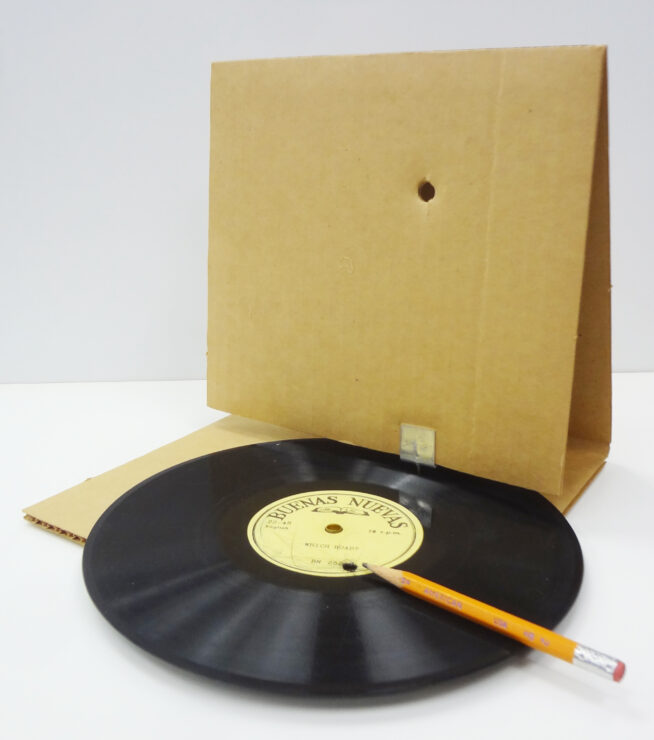 This innovative cardboard record player was recently donated to the Archives by Keith Ulery, who used it in the 1960s when he visited rural villages in Zambia during his service with Brethren in Christ Missions. “The people were amazed to hear a Bible reading and short message in Tonga coming from this small cardboard device,” Keith noted.