Annual Meeting Tells the Story of the Growth of the Brethren in Christ Church in South Florida
By Joshua Nolt
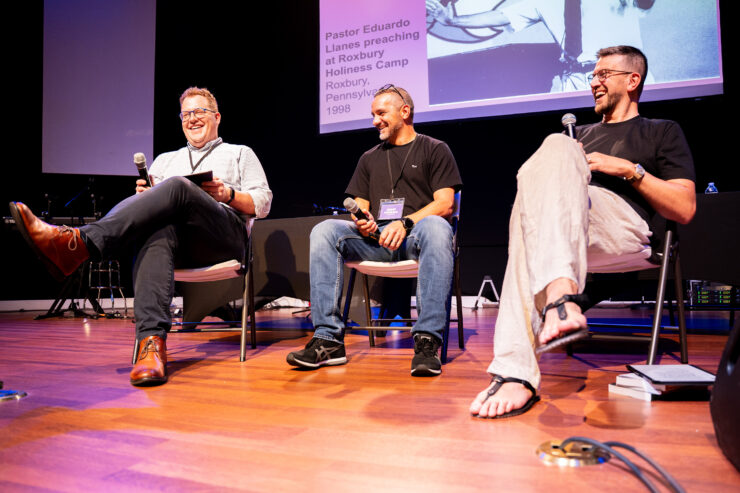
This year’s Historical Society’s Annual Meeting was held as part of the Brethren in Christ U.S. General Assembly. The location of General Assembly in Miami, Florida gave us an opportunity to tell the story of the growth of Spanish-speaking Brethren in Christ congregations in the Miami area over the last several decades. With so many new pastors in the Brethren in Christ and delegates on hand from local congregations across the country, this was the perfect time tell a new group of people the history and life of the churches in the Miami area.
From left to right: Devinb Manzullo-Thomas, Anler Morejon, and Joshua Nolt
The Historical Society hosted one of the breakout sessions during the assembly. We had hoped to have a first-hand account from Eduardo Llanes, former bishop of the Southeast Conference, but unfortunately he was not able to attend at the last minute. Instead, Devin Manzullo-Thomas, Brethren in Christ archivist, shared a brief history and video from the 1990s that told the story of the growth of the Brethren in Christ in the Miami area.
Following Devin’s history, we interviewed Anler Morejon, the pastor of Zion Brethren in Christ Church in Miramar, Florida. After having just watched the video, Anler felt a bit emotional. Yes, he saw his father and younger versions of himself and his wife, but he also saw and spoke about the leaders in the video who were no longer with the church. It was a poignant reminder that the growth we celebrate doesn’t come without challenges.
Anler also helped us recognize the diversity within the Hispanic churches themselves. Majority white, English-speaking churches might look at our sister churches in the Miami area as representative of diversity within the denomination as a whole. However, there is a great deal of diversity within the Hispanic churches themselves. Pastors and congregants come from different parts of the Latino world and bring cultural differences with them. We should recognize and celebrate this diversity within the Latino context; it adds to the richness and texture of the whole Brethren in Christ family in the US.
Attendance at the breakout session was strong, and those present were very engaged during the Q&A time we had at the end with Devin and Anler. We are grateful to have hosted this conversation to help attendees gain a greater understanding of this part of the Brethren in Christ Church family. We encourage readers to watch the recording of the breakout session.
Joshua Nolt is executive director of the Historical Society and senior pastor of the Lancaster (PA) Brethren in Christ Church.
Membership Renewal Time!
If you’re not already a lifetime member of the Society, it’s time to renew your annual membership! A self-addressed envelope is included with this newsletter for your convenience. You can also renew online.
MEMBERSHIP LEVELS
BASIC | $30
CONTRIBUTING | $50
SUPPORTING | $100
PATRON | $200
LIFETIME | $1,000
BASIC NEW MEMBER GIFT | 2 YEARS | $50
We especially encourage older members to give a gift to a young person as a way to introduce the Society to a new generation and thus help to sustain the Society. This special gift membership is a two-year deal—$50, a discount of $10
US checks payable to BRETHREN IN CHRIST HISTORICAL SOCIETY, c/o Lancaster BIC Church, 1865 Fruitville Pike, 17601.
Canadian cheques payable to BE IN CHRIST CHURCH CANADA, c/o Leonard Chester, 109-303 Elgin St., Port Colborne, ON L3K 6A2.
Researching Then and Now
By Dwight Thomas
We all know the huge contribution Dr. E. Morris Sider has made to Brethren in Christ scholarship. I am amazed by the quantity and quality of his work. My recent research has reminded me of the research challenges he and his contemporaries faced, as well as those who went before him. I have been keenly aware of this legacy while researching Enos H. Hess.
I knew from Morris’s biographical sketch in his 1978 book, Nine Portraits, that during the 1890s Enos H. Hess had given agricultural presentations across Pennsylvania. I had questions about where, when, and how many places Hess went. His papers in the archives did not tell me much.
Had I wanted to answer these questions in 1970, I would have needed to physically visit various libraries, slog my way through micro-film or micro-fiche, and take copious notes to get answers to my questions and interpret the results. Morris and his agemates faced similar obstacles in the 1950s and 1960s. Earlier Brethren in Christ researchers faced even greater resource limitations.
By contrast to earlier decades, with my current 2026 resources, I was able use internet tools to obtain information that answered my questions. Some strategic searches of newspapers.com yielded more than one hundred clippings about Hess’s presentations. It gave me place names, times, presentation titles, co-presenters, attendance numbers, and listener reactions. A search of several digital repositories led me to scanned pdfs of the official itineraries for some key years of Hess’s tours. Online digital maps from the 1800s and current Google map tools allowed me to visually chart his 1897-98 trip from Jefferson County in western Pennsylvania to Pike County in eastern Pennsylvania. Armed with these data, I could reconstruct and imagine Hess’s activities during the 1890s. For Morris and his colleagues to accomplish a similar task in 1960 would have been nearly impossible.
Recent internet-based research tools coupled with increased computer power enable us to collect, analyze, and interpret historical events and people with much more detail than was once possible. Moreover, it is far easier than it was even twenty years ago. We are fortunate to have our current resources to assist our historical work. But for me, this also reveals the dedication and scholarly discipline that was needed for work done by earlier Brethren in Christ researchers. I am somewhat intimidated by their work when judging my own, but I am thankful for their example and the legacy they have given us.
Dwight W. Thomas is engaged in a variety of Brethren in Christ research projects in his retirement. Look for his new article on Enos Hess’s journey from farm boy to scientist and educator in the December 2026 edition of Brethren in Christ History and Life.
Vera Gutshall Rice
Faithful Attender at Roxbury Holiness Camp Meeting
By John Hawbaker
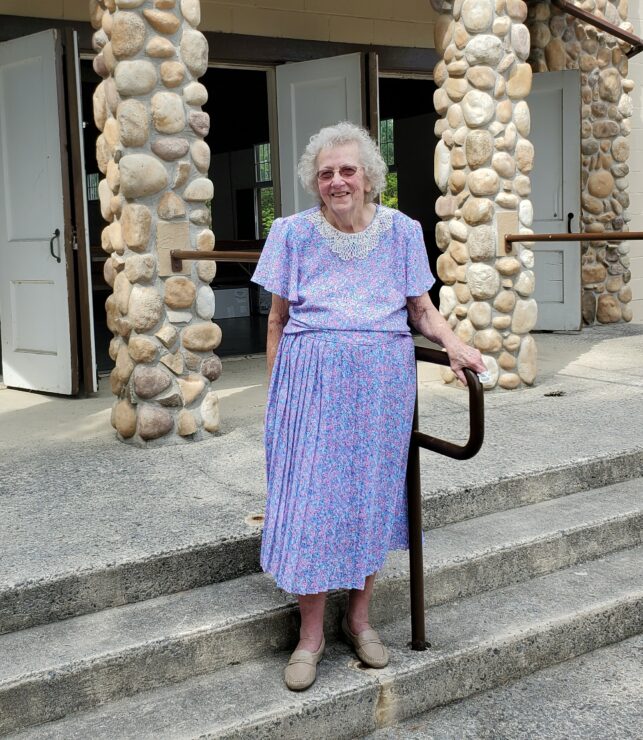
Vera Rice at Roxbury Holiness Camp Meeting, 2021. Photo by John Hawbaker.
At the 2021 meeting of Roxbury Holiness Camp Meeting, I learned that Vera Rice was at Camp this year and had attended every Camp Meeting since its beginning. Since few people were still alive who had attended all the Camp Meetings, I decided to do a brief interview and take some photos.
Vera told me that she was 91 years old and lived on Green Spring Road in Newville, PA. She was the daughter of Reuben and Lottie Gutshall, a deacon couple at the Green Spring Brethren in Christ Church. She married Jacob Rice, and they had five children. She had attended the Green Spring congregation her whole life and was still a member. Her older brother Glen Gutshall was a minister in the Brethren in Christ Church.
Vera passed away in December 2021. As far as I have been able to learn, she was the last living person who had attended every Roxbury Holiness Camp Meeting.
John Hawbaker served as camp director at Roxbury Holiness Camp for many years, in addition to his service as a Brethren in Christ pastor and bishop. In retirement, he and his wife Jolene live at Messiah Lifeways, Mechanicsburg, PA.
News and Notes from the Brethren in Christ Historical Library and Archives
On Writing a New Denominational History, Part 3
By Devin Manzullo-Thomas, archivist
In an earlier issue of this newsletter, I described the kind of sources I’m using in writing a new history of the Brethren in Christ Church in North America. Tentatively titled Open to the Spirit: The North American Brethren in Christ Church in the Twentieth Century, 1900-2000, the book seeks to bring the story of the North American Brethren in Christ Church up to date, to synthesize new research with the many books and articles on Brethren in Christ history that have been written in the last fifty years, and to be readable and compelling to a wide audience.
In this piece, I want to move beyond sources—the stuff from the past that historians use to understand what happened and why it’s significant—and talk about method.
Method refers to what historians do with their sources, the frameworks and ways of knowing that influence how historians read and interpret historical documents. In his magisterial history, Quest for Piety and Obedience, Carlton Wittlinger employed the method of institutional history—a method that, in Wittlinger’s approach, took as its basic unit of analysis the denomination as an organization. Institutional history considers how organizations developed over time. In its simplest form, it chronicles the work of organizational leaders, the changes that they made, and the effects of those changes.
Open to the Spirit will certainly employ the methods of institutional history, since it is important to establish a record of how the organization of the church has evolved. But I am trained as a social historian, and that method will undoubtedly shape how I tell the story of the Brethren in Christ in the twentieth century. Let me say a bit more about it.
Since the 1960s and 1970s, social history has emerged as one of the most important subfields in the historical profession. The British historian E. P. Thompson famously described social history as “history from below,” a phrase that accurately captures social history’s interest in the role of ordinary people in historical change. Social historians pay attention to the lived experiences of women, people of color, working-class people, and others whose contributions to social development are often overlooked by dominant historical narratives.
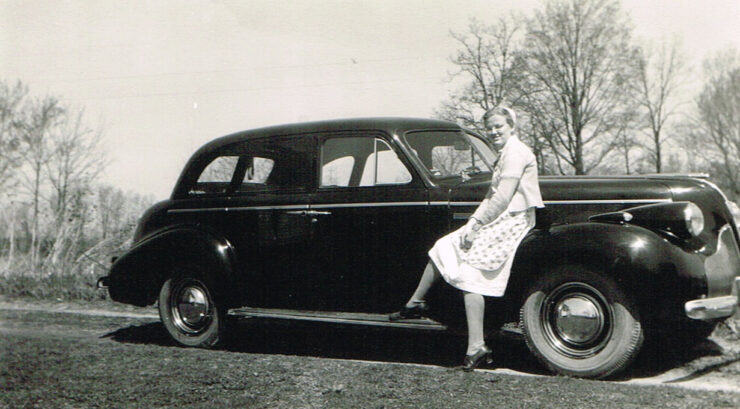
Esther Ebersole as a home mission worker in rural Kentucky in the 1940s or 1950s.
Let me give you a very quick example of what it might look like to narrate Brethren in Christ social history. In one of the book’s chapters, I devote several paragraphs to describing the early Brethren in Christ missionary work in the hills of rural southern Kentucky in the 1940s. I could have narrated this story from the perspective of the Kentucky mission’s long-time field superintendent, a male leader who was credentialed by the denomination for this kind of leadership. Instead, I chose to tell this story from the perspective of a single missionary woman, Esther Ebersole, who moved from the small town of Palmyra, Pennsylvania, to Adair County, Kentucky, in December 1943. Ebersole eventually gave eleven years of service to the Kentucky mission. Her experiences give us a richer portrait of that work than what we could glean from the formal reports of the mission director.
Ebersole wrote of her time in Kentucky as a “cross-cultural experience.” Her upbringing among the quiet, serious, plain-dressing Brethren in Christ of Lebanon County did not prepare her for the shouting, collective praying, and other emotional expressions common in worship services in Kentucky. “Sometimes I wondered why the Lord asked staid me to go,” Ebersole later reflected. Yet the mission field opened many doors for this young, single woman who felt God’s call to ministry and who possessed obvious gifts for it—doors that would have been closed in other corners of the church at that time.
One of those doors was congregational leadership. From her post at the Fairview Mission congregation, Ebersole and another female worker, Esther Greenawalt, led three Sunday schools and prayer meetings and also held preaching appointments in neighboring regions. Years later, Ebersole wrote of this experience: “The Kentuckians did not object to women [in] leadership. There were few men who were Christians, and even those men who were Christians often lacked education which made it difficult to take a leadership role.” In Ebersole’s experience, even leaders from the North practiced an openness to missionary women in positions of ecclesial authority. For one year, 1948-1949, while the Mission Board was trying to recruit a new, permanent, male field superintendent, Ebersole functioned as the resident superintendent of the Kentucky Mission, a position that involved formal oversight of all the workers—both male and female—in the state. In reflecting on this decision years later, Ebersole noted that the Mission Board passed over two male missionaries on the field in Kentucky when they chose her for the interim role.
Telling the story of the early development of the Kentucky Mission from Esther Ebersole’s perspective gives us a richer, more textured, and more nuanced view of the Brethren in Christ missionary endeavors at this place and in this time. It also gives us a deeper portrait of the experience of women in the church. If I’d tried to tell this same story using the methods of institutional history, official records might have reduced or even obscured Ebersole’s leadership, since, on paper, women were blocked from this kind of leadership in the 1940s and 1950s. But the lived experience—the social experience—of Esther Ebersole tells a different story, a more complex story, and our understanding of Brethren in Christ history is better for it.
Images from the Past
From the photograph collection of the Brethren in Christ Historical Library and Archives
Do You Recognize This Farm?
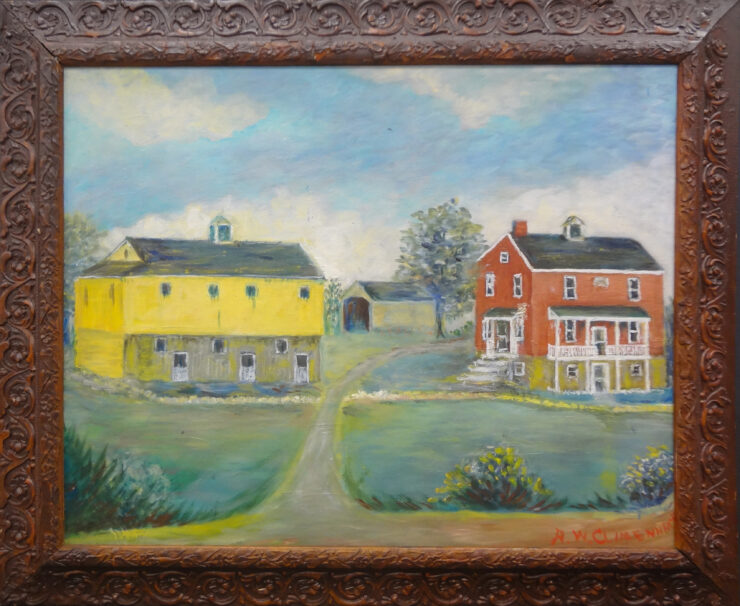
The Messiah University Archives recently received a painting by Asa W. Climenhaga, donated by a member of the Harrisburg (PA) Brethren in Christ Church. The untitled painting came with very little identifying information, except for this statement written on the back of the frame: “Farm Building – 110 Acres Owned by A. W. and A. E. Climenhaga – Messiah College Campus Now Ownes [sic] Most of the Land”
Do any Historical Society members recognize what farm is depicted in this painting, and where it would have been located? Contact the Archives with any information.