Historical Society Annual Meeting to be Held During General Assembly
The biennial General Assembly of Brethren in Christ U.S. will be held in Miami, Florida on July 24-27, 2026. The Historical Society is taking advantage of the occasion and will hold its 2026 annual meeting during the assembly. On Saturday, July 25, one of the regularly scheduled breakout sessions will be sponsored by the Historical Society and will feature “The History and Life of the Brethren in Christ Church in Miami.”
The last time General Assembly was held in Miami was in 2006. Since then, many pastors and leaders have entered into the Brethren in Christ Church and have yet to hear the origin story of the presence and growth of the Brethren in Christ in Miami. This session is about both sharing the origin story and the present day life of Brethren in Christ churches in Miami.
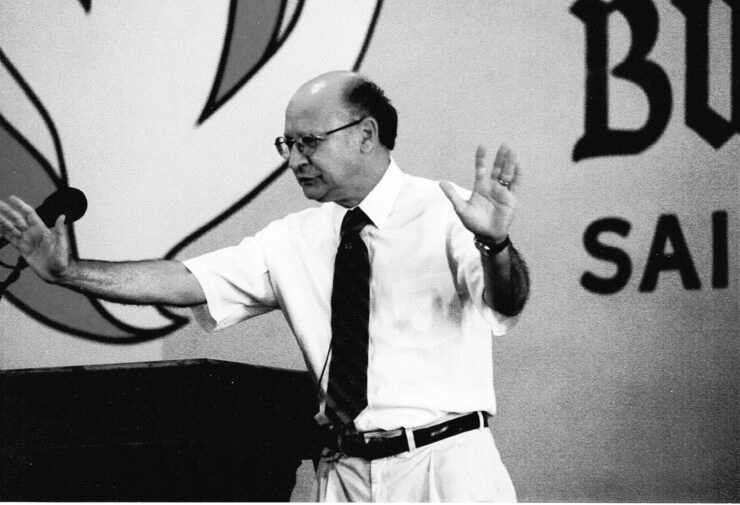
Eduardo Llanes, then supervisor of the South Florida churches, preaching during Missions Day at Roxbury Holiness Camp, 1998.
Through a dialogue between Devin Manzullo-Thomas and Eduardo Llanes, we will cover the “history” of the Brethren in Christ Church in Miami. Devin is director of the Brethren in Christ Historical Library and Archives, and Eduardo is an immigrant from Cuba who was an influential leader helping to launch the Brethren in Christ in Miami. He then became the first bishop of the newly-formed Southeast Conference. Following the discussion on history, we will discuss the present day “life” of the Brethren in Christ in Miami through a dialogue between Joshua Nolt and Anler Morejon. Joshua is the executive director of the Historical Society and pastor of Lancaster (PA) Brethren in Christ Church, and Anler pastors the Zion congregation in Miramar, FL.
If you will be attending General Assembly, we invite you to join us for this conversation that will give you more background and appreciation for the location of the assembly and our Miami churches. Watch the conference schedule for the location and time of the session.
Copies of STORYTELLER Still Available
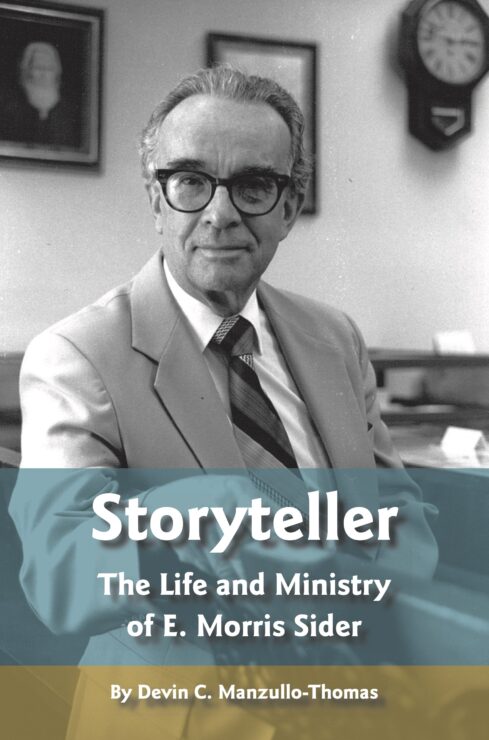
We still have copies for sale of Devin Manzullo-Thomas’s 2025 biography, Storyteller: The Life and Ministry of E. Morris Sider. Buy one for a friend, for one of Morris’s former students, for your church library, or anyone else who might be interested in the life of this remarkable man who contributed so much to the Brethren in Christ Church. Order online at https://bic-history.org/books/, or contact the editor.
Isaac John Ransom: Brethren in Christ Fundamentalist
By Devin Manzullo-Thomas
One of the underexplored areas of Brethren in Christ history is the denomination’s ties to Protestant fundamentalism. This movement emerged in the late nineteenth and early twentieth centuries as a reaction against what some viewed as threats to the Christian moral order in society—such as women’s liberation, evolutionary biology, and non-Protestant immigration—and against the “liberal” Christians who supported these developments.
Fundamentalists popularized two key doctrines: inerrancy, a belief in the scientific errorlessness and perspicacity of the Bible; and dispensational premilliennialism, a belief about the second coming of Christ that introduced into Protestant theology such concepts as the rapture and the seven-year tribulation preceding the millennial reign of God. Both of these beliefs are reflected in Brethren in Christ writings from this era.
In researching and writing a new history of the North American Brethren in Christ Church, I’ve discovered many of these fundamentalist-influenced writings—and a little-known but seemingly influential Brethren in Christ fundamentalist named Isaac John (I. J.) Ransom.
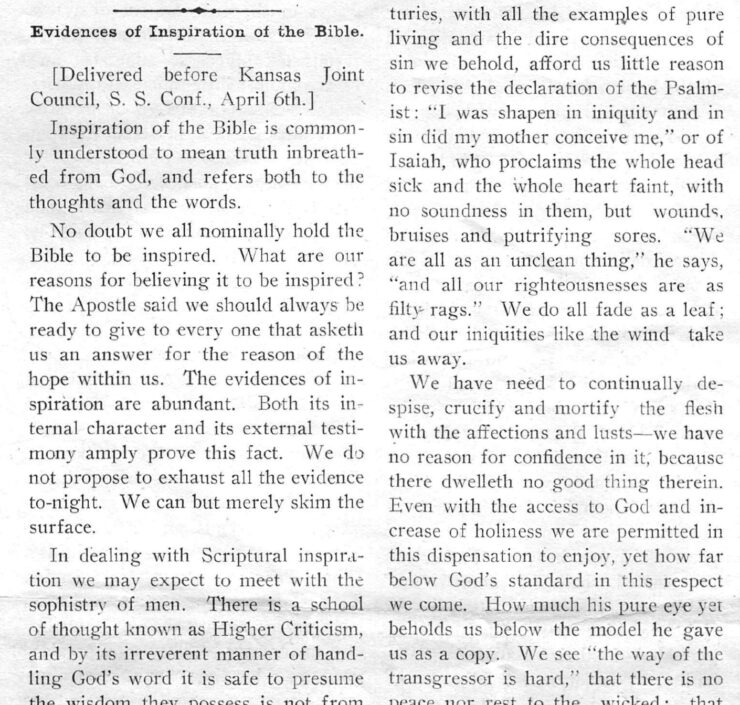
Excerpt from one of Isaac John Ransom’s articles in the Evangelical Visitor.
Born in India in 1871 to a British father and Irish mother, Ransom eventually immigrated to the United States and settled first in Pennsylvania and later near Abilene, Kansas. Raised Quaker, he was drawn to the Brethren in Christ and united with the church around 1898. Soon thereafter he became a frequent contributor to the Evangelical Visitor, the church’s official newspaper. His favorite subject appears to have been dispensationalism.
For example, in a series of Bible studies of Genesis and Matthew published in 1902, Ransom repeatedly used both biblical texts to explicate a fundamentalist vision of Christ’s second coming. In one article, he interpreted Enoch entering heaven without dying as referring to the rapture. In another, he argued that Noah’s divine protection during the great flood foreshadowed Christ’s protection of the saints during the seven-year tribulation after the rapture. Ransom even asserted, quite boldly and without much evidence, that “one verse out of every 25 in the Bible refers to” the second coming of Christ.
Ransom’s devotion to dispensationalism likely deepened during his years attending two different Bible schools: BIOLA (1902) and the Toronto Bible Training School (1905-1908), both of which were fundamentalist hubs and both of which he attended while maintaining his ties to the Brethren in Christ.
Although he did not have deep roots in the denomination, Ransom appears to have wielded some influence in it. Starting in June 1902, for example, he held editorial responsibilities for the Visitor’s short-lived “Bible Study Department.” In 1904, he was invited by several Kansas churches to present a paper on “Evidences of Inspiration of the Bible.” Although he stopped short of fully invoking inerrancy, he championed the Bible’s “verbal inspiration” and decried liberal Christians’ “irreverent manner of handling God’s word.” For several years Ransom “found a very open door and opportunity for Bible readings [among] the Brethren in Canada and Clarence Center, New York,” according to one account. Although eventually denied ministerial credentials by the denomination and, in his own words, choosing to labor “in other fields of service for the Master,” he nevertheless may have been for a time quite influential in spreading fundamentalist ideas among the Brethren in Christ.
Devin Manzullo-Thomas is a faculty member and director of archives at Messiah University.
News and Notes from the Brethren in Christ Historical Library and Archives
Balopticon Donated to Archives
By Dwight W. Thomas
Early Brethren in Christ were cautious adopters of technology when it was perceived as “frivolous,” and they applied their reluctance to various areas of life, including photography. Wedding photos, pre-membership photos, and mission-related photos escaped harsh restrictions, but concerns remained nevertheless. In an earlier journal article, I wrote about the Clifford Cress photographs of Matopo, which are housed in the Brethren in Christ Historical Library and Archives and represent the earliest known photographs taken by a church member. Frances Davidson used some of Cress’s as well as Steigerwald’s and Taylor’s in her 1915 book, South and South Central Africa. So, some photos slipped into church hands.
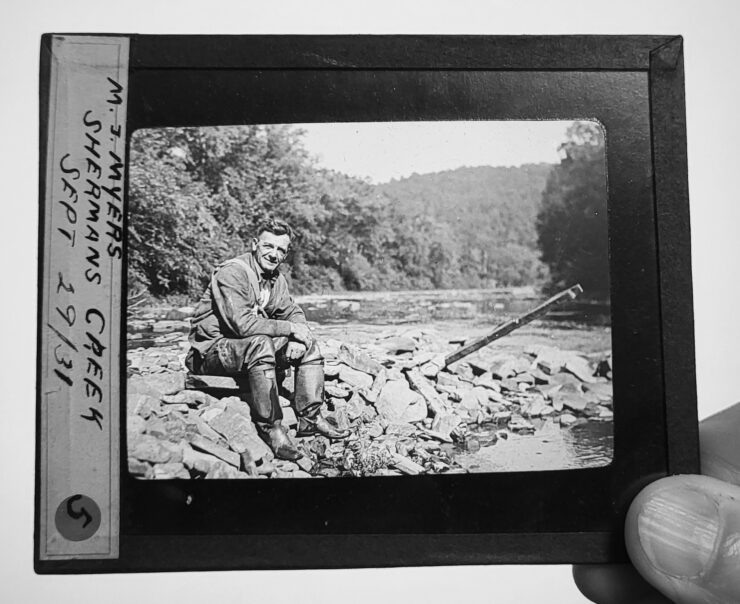
Some time ago, I discovered that the archives also has some interesting “glass slides” –positive photos sometimes called “lantern slides.” They are a second form of PhotoTech, and gave clear evidence that some Brethren in Christ used lantern slides and lantern slide projectors for selected purposes. But the archives had no lantern slide projector to view them. So, I checked Ebay to see what might be available and found a projector for sale by an Elizabethtown friend, Bob Gruber. I inquired, and he generously offered to donate the projector to the archives.
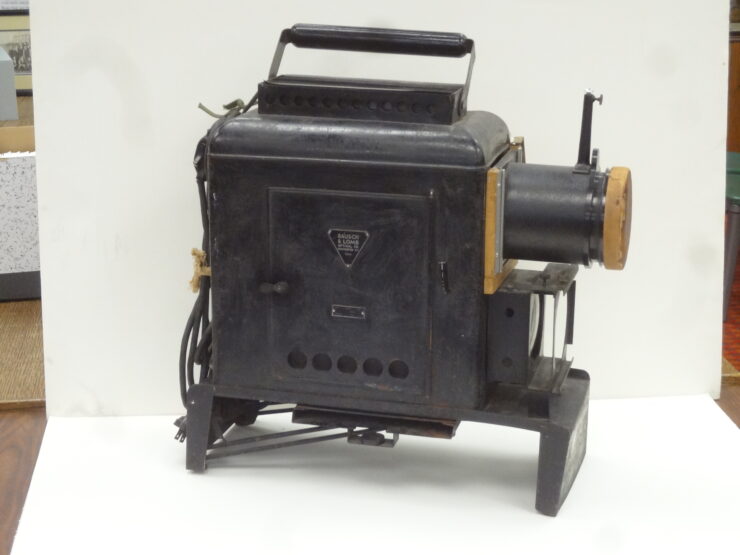
The Balopticon slide projector donated to the Archives.
The machine and its use
A closer look at the projector revealed that several parts were missing, but the unit is still interesting. The manufacturer’s name, Bausch Lomb, can be seen on a side label and this brand was very common. The projector has two lenses, one with a cardboard cap. Inside, I found an electric bulb and an angled mirror. Follow-up research identified the projector as a Balopticon, which is a combination projector designed to project either slides or positive opaque prints. In short, it is both a slide projector and the ancestor of the mid-twentieth century “overhead projector.” The two lenses, the angled mirror, and other mechanisms enable users to switch between slide and opaque image modes.
We do not know what projector models were used by the Brethren in Christ, but slide shows—often called “illustrated lectures” – appear in the record as early as the 1910s. Lantern projectors were used more generally in educational, medical, and community contexts. Slide sets of the time included photos of distant places, maps and drawings, plants and flowers, agricultural methods, religious scenes, artwork and architecture, texts to hymns and songs, and other theme-oriented topics. During the 1920s, Pennsylvania State Museum maintained a huge collection of lantern slide sets through its Division of Lantern Slides, and loaned them out to schools and community groups for illustrated lectures.
We know for certain that Messiah Bible College borrowed at least one set of slides with images from Yellowstone National Park through the state loan program for an illustrated lecture sponsored by the school’s Milton Society. Each set of slides had an accompanying set of printed cards which could be read as the slides were shown, so presumably members of the society read the cards. Commercial companies also sold supplies for creating custom slides, and it is likely that both Beulah and Messiah College teachers created their own slides, as the educational benefits would have been obvious.
The positive image projection feature of a Balopticon enabled schools and hospitals to show medical pictures or specimen slides for medical and scientific purposes. One advertisement notes that viewers could watch microbes wiggle around via Balopticon projected specimen slides. Users could also have projected locally-shot photographs for group viewing, and one can easily imagine students at Beulah and Messiah enjoying an evening viewing photographic prints of their classmates’ latest adventures.
Despite the adoption of lantern slide shows at Messiah and Beulah Colleges, the broader Brethren in Christ community continued to have misgivings about photographs and public viewings. Sentiment was strong enough that the General Conference took several formal actions as late as the 1940s to govern slide shows in churches. Interestingly, during the late 1930s and early 1940s, Jesse Lady showed lantern slides of his Europe and Holy Land trips at various central Pennsylvania events, including appearances in several Brethren in Christ venues. One wonders whether his technological enthusiasm might have contributed to denominational concerns.
More research remains to be done, but the archive acquisition of the Bob Gruber Balopticon adds another unique item that relates to Brethren in Christ engagement with technology.
Dwight W. Thomas spends much of his time in retirement researching Brethren in Christ history and uncovering interesting tidbits from the past.
Images from the Past
From the Photograph Collection of the Brethren in Christ Historical Library and Archives
As General Assembly 2026 convenes in Miami, FL, it’s worth remembering that the Brethren in Christ churches in that city owe their origins to the Brethren in Christ of Cuba.
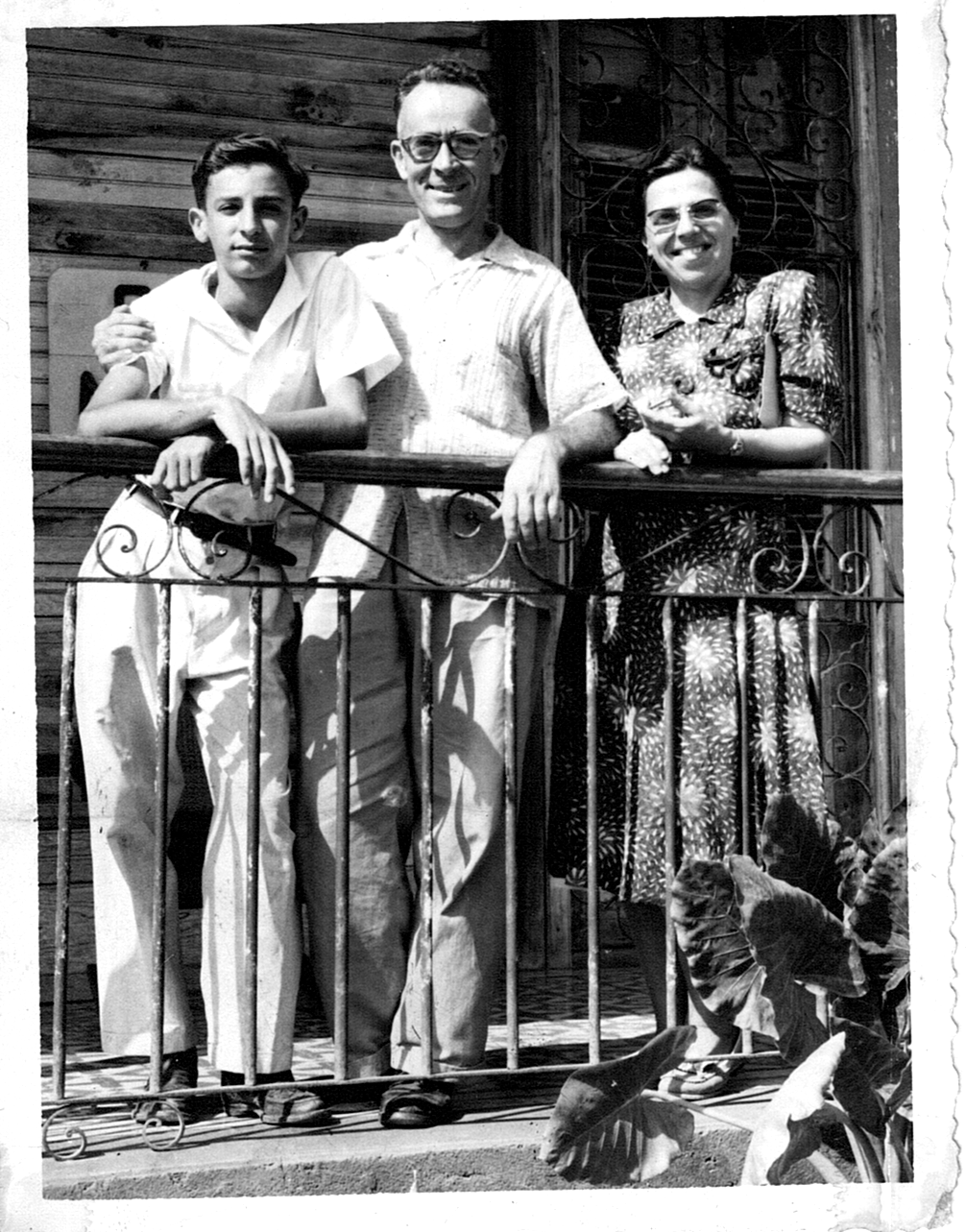
In 1954, North American missionaries Howard and Pearl Wolgemuth moved to the town of Cuatro Caminos, where they established a small church. Among their earliest converts was Eduardo Llanes (pictured below with the Wolgemuths). A teenager, Eduardo nevertheless rose to leadership positions in the fledging congregation. When the 1959 Communist revolution forced missionaries to leave the country, Eduardo followed the Wolgemuths—first to Jamaica and then to the United States, where he eventually became a minister.
In 1985, the Brethren in Christ Board for Evangelism and Church Planting recruited Eduardo to start a new church in the bustling metropolis of Miami. Eventually, that single congregation grew into a network of churches in South Florida.
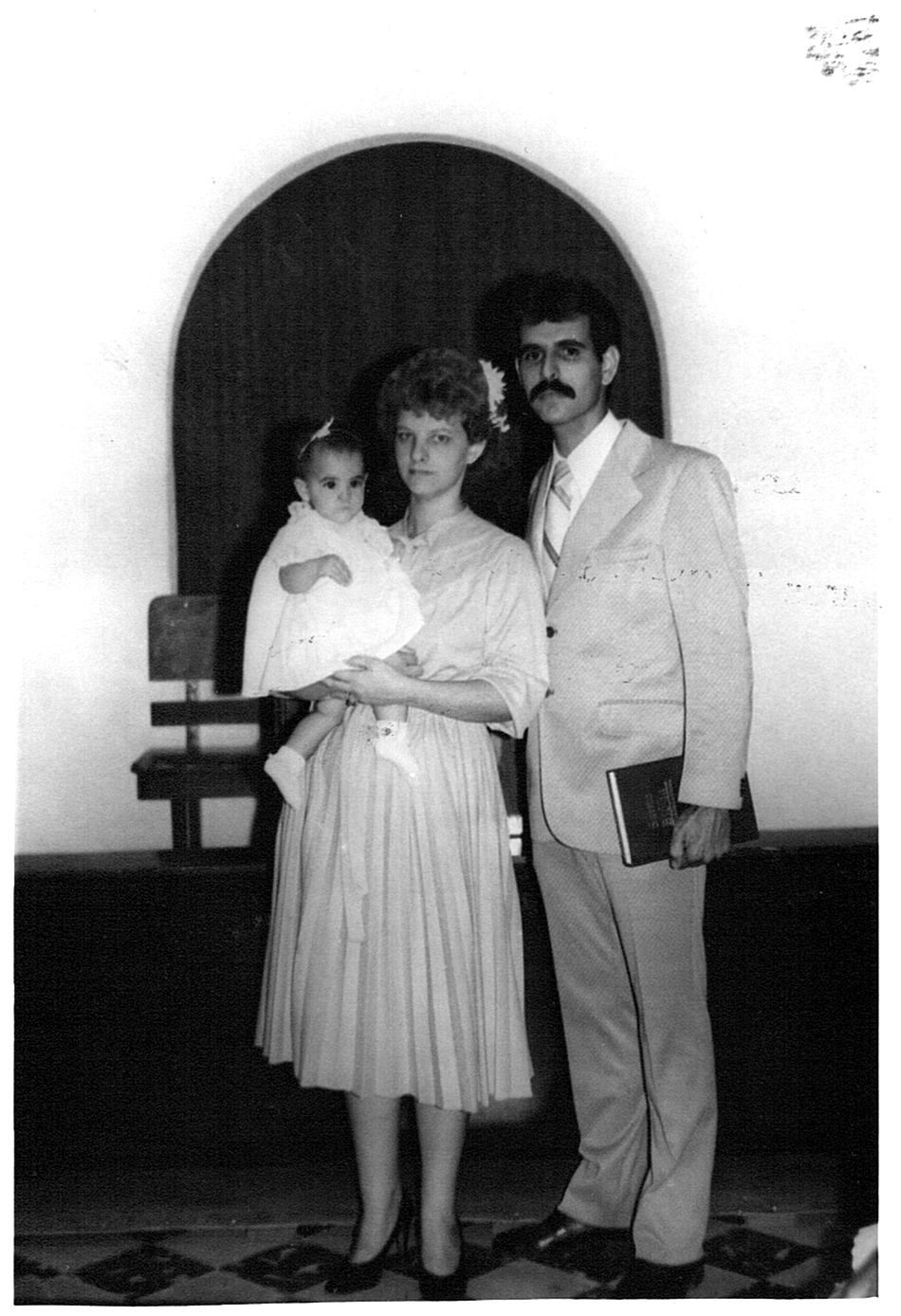
Meanwhile, back in Cuba, the Brethren in Christ Church continued to flourish despite the challenges posed by the Communist government and the United States’ economic embargo. One young minister was Jose Rodriguez, who with his wife, Lourdes (pictured below right), and their children immigrated to the United States in 1989. There he connected with Eduardo, served as an assistant pastor, and eventually founded the Esmirna Brethren in Christ congregation in 1998.

 We know for certain that Messiah Bible College borrowed at least one set of slides with images from Yellowstone National Park through the state loan program for an illustrated lecture sponsored by the school’s Milton Society. Each set of slides had an accompanying set of printed cards which could be read as the slides were shown, so presumably members of the society read the cards. Commercial companies also sold supplies for creating custom slides, and it is likely that both Beulah and Messiah College teachers created their own slides, as the educational benefits would have been obvious.